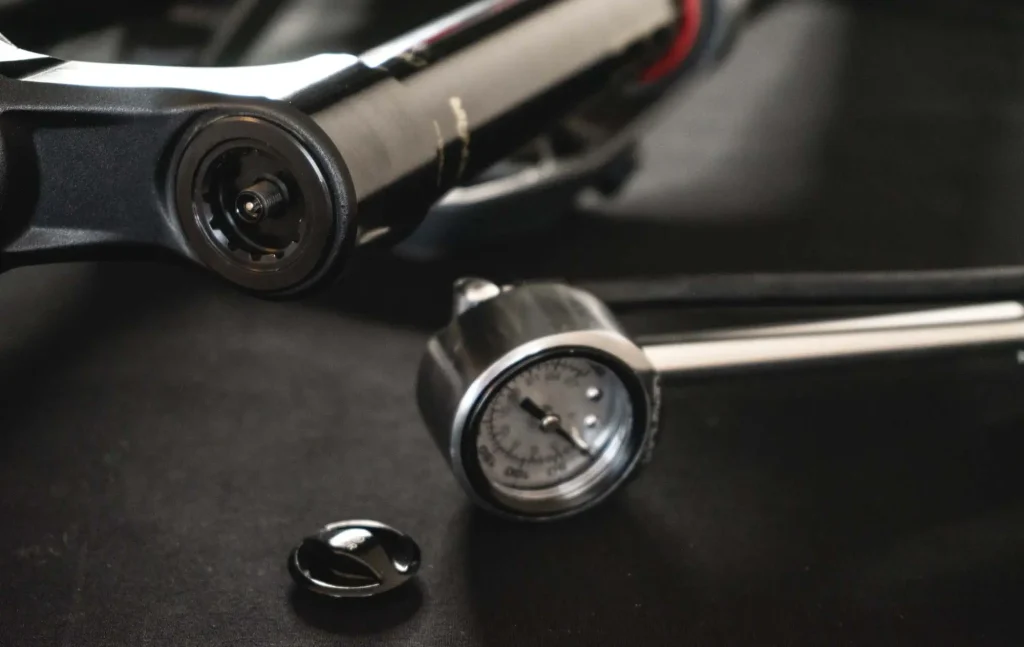
Why Your Shock Pump Reads Lower Pressure: MTB Shock Pump Guide for Rear Shock Pressure Setup
If you have ever checked your rear shock pressure and thought, “Why does my shock pump show less PSI than I expected?”, you are not alone. This is one of the most common suspension setup questions in mountain biking. Many riders think their shock is leaking, when in reality the pressure reading often drops simply because of how a shock pump works. In this MTB shock pump guide, we explain why this happens, how to check pressure properly, and how to build a more accurate rear shock pressure setup without guessing.
Why your shock pump shows a lower pressure reading
The most important thing to understand is that your suspension air chamber is very small. Compared with a tire, the amount of air inside a fork or rear shock is tiny. When you connect your shock pump, the hose of the pump is initially empty. As soon as the valve opens, some of the air from the shock moves into the hose so the pressure can equalize across the whole system.
This means your shock pump can immediately display a lower pressure than the actual pressure that was inside the shock before the pump was attached. On some setups, this difference can be around 10 psi or more, especially on high-pressure rear shocks with small air volume.
So if your gauge suddenly looks lower, that does not automatically mean your shock lost air while riding. In many cases, it simply means the air is now shared between:
- the air chamber inside the rear shock
- the Schrader valve area
- the hose and gauge of your shock pump
This is one of the biggest reasons why riders struggle with rear shock pressure MTB setup when they first start learning suspension tuning.
Does your rear shock actually lose air when you attach the pump?
Usually, not in the way most riders think. The common mistake is assuming that the pressure drop on the gauge means the shock itself has leaked. Most of the time, the reading changes because the pump hose has to fill with air. That is a normal physical effect.
There is another confusing moment when you remove the pump. You often hear a short hiss and assume air is escaping from the shock. In most cases, that sound comes mainly from the air inside the hose of the pump, not from the rear shock itself. Once the valve closes again, the shock remains sealed.
This is why many riders believe they have a leak even though the real issue is just misunderstanding how a shock pump behaves.
Why repeated pressure checks can create suspension setup confusion
One of the most common setup mistakes is checking pressure too often without a clear method. Riders attach the pump, see a lower number, add a little air, disconnect, ride, then check again and repeat the cycle. Over time, this can lead to an inconsistent setup process where you are reacting to gauge readings instead of setting the bike based on sag and trail feedback.
A better approach is to use pressure as a starting point, not as the only truth. Air pressure matters because it helps you reach the correct sag. But the final setup should always be checked through actual riding feel and structured testing.
Rear shock pressure MTB: why PSI alone is not enough
Many riders focus too much on PSI and not enough on what the suspension is actually doing. The pressure number matters, but it is mainly there to help you reach the correct sag. Sag is the amount the suspension compresses under your body weight in riding position, and it is one of the most important foundations of any mountain bike suspension setup.
If your pressure is too high, the bike may feel harsh, ride too high in its travel and struggle for grip. If your pressure is too low, the suspension may dive too much, feel vague and bottom out too easily. That is why a structured setup process should always start with a baseline pressure, then verify sag, then fine-tune rebound and compression.
If you want a good starting point, use an MTB PSI calculator to estimate a reasonable baseline before checking your sag.
How to use a shock pump correctly
Using a shock pump correctly makes a big difference. Here is a simple process that works well for most riders:
- Make sure the suspension is fully extended. Do not check pressure while the shock is compressed.
- Attach the pump cleanly and firmly. Be careful not to cross-thread the valve.
- Accept the first gauge reading as part of the system equalization. The number may be lower than you expected.
- Adjust in small steps. Add or remove only a few psi at a time.
- Cycle the suspension a few times. Compress and release the shock to help everything settle.
- Check sag. PSI is only useful if it puts you into the right sag range.
- Document your settings. Write down air pressure, sag, rebound clicks and trail feedback.
The more repeatable your process is, the easier it becomes to actually improve your setup.
How to build a reliable rear shock pressure setup
A strong rear shock pressure setup should follow a logical order. Many riders jump straight into random changes, but the best suspension tuning process is much more systematic.
- Start with a baseline pressure recommendation.
- Set your rear shock sag correctly.
- Set rebound to a sensible baseline.
- Set compression damping to a sensible baseline if your shock has it.
- Ride a repeatable trail section.
- Change only one variable at a time.
- Take notes after every adjustment.
This is the approach serious riders use when they want a bike that feels predictable and balanced rather than random and inconsistent.
MTB shock pump guide: common mistakes to avoid
Here are some of the most common mistakes riders make when checking shock pressure:
- Chasing the exact same PSI number every time instead of setting sag properly.
- Ignoring rider gear weight such as shoes, helmet, backpack or water.
- Changing pressure, rebound and compression all at once, making it impossible to know what helped.
- Testing on random trails instead of one repeatable section.
- Assuming every bottom-out is bad. Using full travel occasionally can be normal on hard hits.
- Blaming the shock pump immediately instead of understanding air chamber behavior first.
A better setup process is slower, more methodical and more repeatable.
Why front and rear suspension balance matters
Rear shock pressure should never be considered in isolation. Your rear shock and fork work together as one system. Even if your rear shock pressure is technically correct, the bike can still feel wrong if the front and rear are out of balance.
Examples:
- If the rear is too soft and the fork is too firm, the bike may feel like it rides nose-high and pushes through corners.
- If the rear is too firm and the fork is too soft, the bike may dive in front and feel unbalanced on steep terrain.
- If rebound is mismatched front to rear, the bike can feel nervous or unsettled in repeated impacts.
That is why good suspension tuning is not just about finding “the right rear shock pressure MTB value.” It is about finding a balanced setup for the whole bike.
How an MTB PSI calculator helps
An MTB PSI calculator is useful because it gives you a realistic starting point based on your rider weight, bike category and suspension type. It helps reduce guesswork and gets you closer to the right setup faster.
This is especially helpful when:
- you set up a new bike for the first time
- you switch to a different fork or shock
- you have never tuned your suspension systematically before
- you want a baseline before making trail-specific adjustments
But it is important to understand what a calculator can and cannot do. A suspension setup calculator is not a replacement for riding feedback. It cannot fully know your speed, line choice, local trails or personal preferences. It gives you the baseline. The trail tells you the rest.
If you want to start from a structured baseline, check the SAGLY MTB PSI calculator and then continue with sag, rebound and trail testing.
When your bike still feels wrong even if PSI seems correct
Sometimes your gauge reading is fine, but the bike still feels off. In that case, the problem is often not air pressure alone. It may be:
- rebound that is too slow or too fast
- compression damping that is too firm
- front and rear imbalance
- tire pressure masking suspension feel
- poor setup for the specific trail conditions
- service intervals being overdue
This is why riders who really want to improve should use a structured setup workflow instead of only watching PSI numbers.
Conclusion: use pressure as a baseline, not as the whole answer
If your shock pump reads lower pressure when you attach it, that does not automatically mean your rear shock is leaking. In many cases, it is simply the result of the pump hose filling with air and the pressure equalizing across a larger volume.
The key is to stop guessing and start following a consistent process:
- start with a realistic pressure baseline
- use an MTB PSI calculator
- set your sag correctly
- fine-tune rebound and compression one step at a time
- track your settings and compare trail feedback
That is how you build a suspension setup that actually works on the trail instead of just looking right on the gauge.
Want a better starting point for your fork and rear shock setup? Use SAGLY to calculate baseline settings, document your setup and improve your suspension step by step.
FAQ: MTB shock pump and rear shock pressure
Why does my shock pump show lower pressure when I attach it?
Because the hose of the pump has to fill with air when you connect it. That increases the total air volume of the system for a moment, so the gauge can show a lower pressure even when the shock is not leaking.
Does attaching a shock pump let air out of my rear shock?
Not usually in a meaningful way if the pump is working correctly. The hiss you hear when disconnecting the pump often comes from the air inside the pump hose, not from the shock itself.
What is the correct rear shock pressure for MTB?
The correct pressure depends on rider weight, bike type, rear shock model and riding style. A good starting point is to use an MTB PSI calculator and then verify your sag before fine-tuning.
Is PSI more important than sag?
No. PSI is mainly the way you reach the correct sag. Sag is the more useful setup reference because it reflects how the bike actually sits under your body weight.
Can an MTB PSI calculator replace trail testing?
No. A calculator gives you a strong baseline, but the final setup still depends on trail feedback, rebound, compression and the balance between front and rear suspension.

Download SAGLY, the complete mobile guide for MTB suspension setup, maintenance and step-by-step bike tuning.