
MTB fork setup guide
How to Adjust Front Suspension on a Mountain Bike
Set fork air pressure, SAG, rebound and compression in the right order, then fine-tune the result on a repeatable trail section.
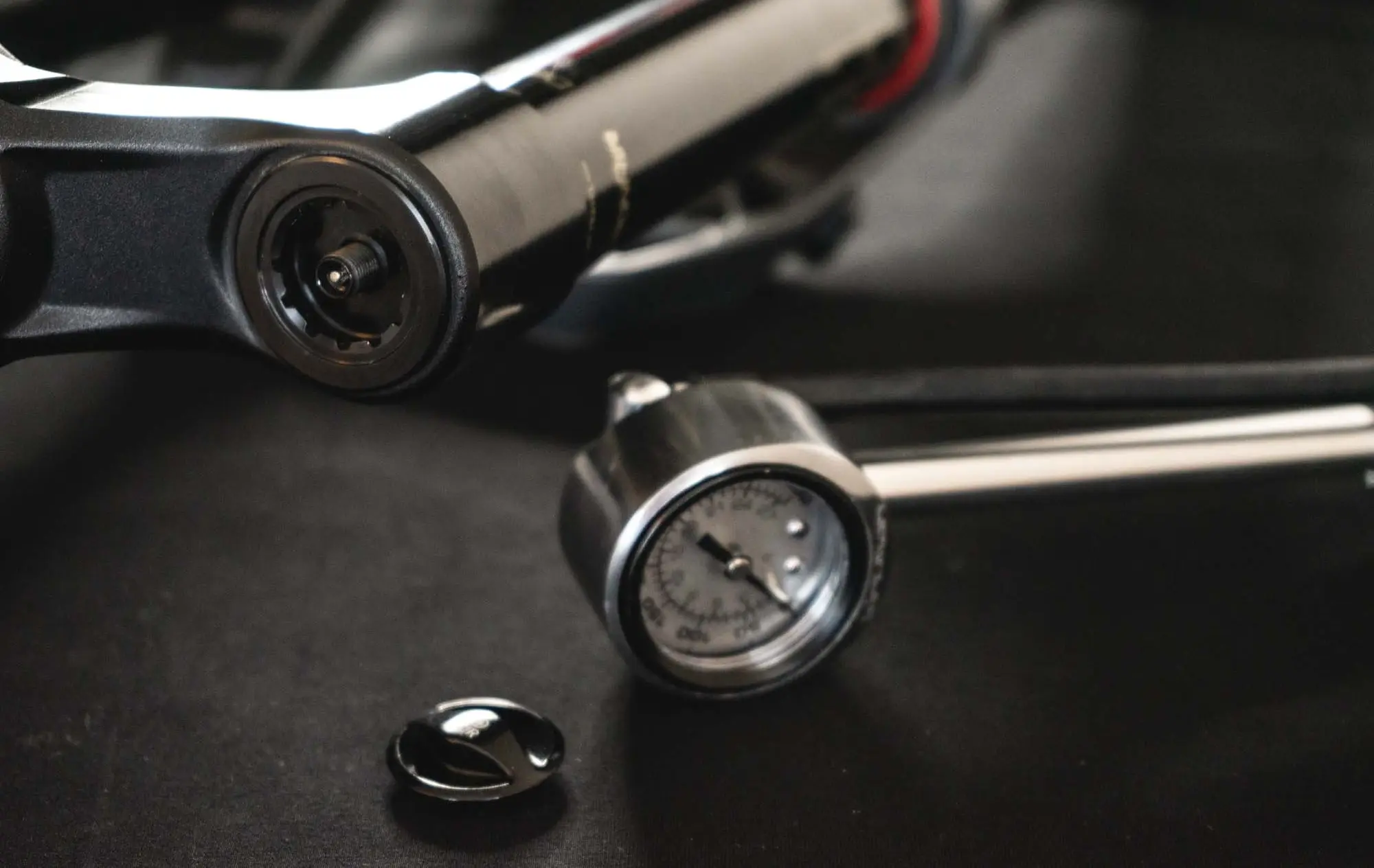
Quick answer
To adjust MTB front suspension, first check tire pressure and basic fork condition. Identify the exact fork, damper and travel, then use the manufacturer’s model-specific recommendation as the safest pressure or spring starting point. Measure fork SAG with your normal riding equipment, set rebound from the recommended baseline, set compression according to that damper’s open, neutral or middle reference, and test one change at a time on the same trail section. Consider volume spacers only after pressure, SAG and damping are already close.
Go to the detailed setup stepsBuilding your complete bike setup? Follow the complete mountain bike suspension setup guide to set tire pressure, fork, rear shock, SAG, rebound and compression in the correct order.
Why front-suspension setup matters
Your fork controls how the front wheel follows the ground, how the bike behaves under braking and how much confidence you have when the trail gets rough. A useful fork setup improves grip, comfort, cornering support, braking control and travel use without making the bike feel harsh or vague.
The aim is not to find one perfect number. The aim is to create a safe baseline, test it consistently and adjust it until the front of the bike feels predictable for your terrain and riding style.
What can be adjusted on an MTB fork?
Not every fork has every adjustment. Entry-level forks may offer only spring preload or air pressure and rebound. More advanced forks can include separate low-speed compression, high-speed compression, volume spacers and hydraulic bottom-out control.
| Setting | What it controls | Common symptom when incorrect |
|---|---|---|
| Air pressure or coil spring rate | The spring force that supports rider weight and holds the fork in its working range. | Too firm can reduce grip and comfort. Too soft can cause excessive dive or frequent bottom-outs. |
| SAG | The amount of fork travel used under normal riding load. | Too little can feel tall and harsh. Too much can feel low, vague or under-supported. |
| Rebound | How quickly the fork returns after compression. | Too little damping can feel bouncy or nervous. Too much damping can cause packing down on repeated impacts. |
| Low-speed compression | Resistance to slower damper-shaft movements from braking, pumping, cornering and rider weight shifts. | Too little can feel divey. Too much can reduce sensitivity and grip. |
| High-speed compression | Resistance to faster damper-shaft movements from sharp rocks, roots, landings and hard compressions. | Too little can blow through travel on hard hits. Too much can feel harsh on sharp impacts. |
| Volume spacers | Air-spring progression deeper in the travel. | Too many can block deep travel. Too few can allow easy bottom-outs even when the start of travel feels right. |
| Hydraulic bottom-out | Extra damping support near the end of travel on forks that include it. | Incorrect settings can affect hard landings or deep compressions, but availability and function are model-specific. |
The correct MTB fork setup order
Setup order matters because each setting changes how the next one feels. Rebound depends on spring force. Compression tuning makes little sense if pressure is far away. Volume spacers should not be used to hide a basic pressure or damping problem.
- Verify tire pressure and basic bike condition.
- Identify the exact fork, damper and travel.
- Set manufacturer-recommended starting pressure or spring.
- Equalize air chambers where the fork requires it.
- Measure fork SAG.
- Set rebound.
- Set compression according to the damper baseline.
- Test on a repeatable trail section.
- Adjust volume spacers only if the travel curve needs changing.
- Save the setup and record feedback.
For the complete bike-level sequence, read the MTB suspension setup-order guide .
Step 1 – Check tire pressure and fork condition
Tire pressure can imitate suspension problems. A front tire that is too firm can make the fork feel harsh and vague. A tire that is too soft can fold, squirm or make the front feel unsupported. Start with a sensible tire baseline before you judge the fork.
Quick inspection
- Front tire pressure is in a normal range for your tire, rim and terrain.
- Fork stanchions are clean.
- No visible oil leakage around seals or adjusters.
- Axle and headset are secure.
- Fork moves without obvious binding.
- No unusual knocking, scraping or sucking noises.
Know when to stop tuning
Persistent harshness, stiction, unusual noise, oil leakage or inconsistent damping may be a service issue. Do not try to solve a mechanical problem with more pressure, more damping or more volume spacers.
Step 2 – Identify the exact fork
Record the brand, model, generation or model year where possible, travel, wheel size, damper and whether it uses an air or coil spring. A name such as “Pike” or “36” is not enough on its own because air springs, dampers, travel options and setup references can change between generations.
If you have a RockShox fork, use the serial number and model information, then follow the RockShox fork setup guide for brand-specific setup context. For any brand, the model- and travel-specific manufacturer recommendation is the safest starting point.
Step 3 – Set the starting air pressure
Use total riding weight, not body weight alone. Include helmet, shoes, pack, water, tools and the equipment you normally carry. Then find the official baseline for your exact fork model and travel.
Attach a shock pump carefully, note that connecting the pump can slightly change the displayed reading, and adjust in small steps. Many air forks need to be cycled during setup so positive and negative chambers equalize. Follow the manual, cycle the fork where required, reconnect the pump and recheck the pressure.
Never exceed the manufacturer’s maximum air pressure or service instructions. Avoid generic body-weight-to-PSI tables when a model-specific recommendation is available. For a broader pressure-focused explanation, use the MTB fork air pressure guide.
Step 4 – Measure and adjust fork SAG
SAG is a useful baseline, not an absolute performance target. A common starting area for many MTB forks is approximately 15-20%, but the correct value depends on fork model, travel, air-spring design, bike geometry, terrain, riding style and manufacturer guidance.
Fork SAG calculator
Enter your fork travel and the distance the O-ring moved while you were standing in a normal riding position.
Important: the result is a measurement aid, not a model-specific pressure recommendation. Follow the guidance for your exact fork and confirm the setup on the trail.
Fork SAG formula
SAG percentage = measured O-ring movement / fork travel x 100
Example: a 160 mm fork with 29 mm of O-ring movement has 29 / 160 x 100 = approximately 18% SAG.
Repeatable measurement process
- Wear normal riding equipment, including pack and water if you usually carry them.
- Open or neutralize compression settings according to the manufacturer’s guidance for that damper.
- Move the O-ring down to the dust wiper.
- Take a normal attack position with weight balanced through hands and feet.
- Avoid bouncing or grabbing the front brake hard.
- Step off carefully without compressing the fork again.
- Measure the O-ring movement and repeat the measurement.
For a focused explanation of measurement and interpretation, calculate and measure MTB fork SAG on the dedicated page.
Step 5 – Set rebound
Rebound controls how quickly the fork returns after being compressed. More rebound damping generally means a slower return. Less rebound damping generally means a faster return. The right setting depends on the fork, spring pressure, rider load, terrain and how the bike behaves under repeated impacts.
Start from the manufacturer baseline. Click-counting conventions differ, so record the reference direction you used, such as “clicks from fully closed/slow”, and verify that convention in the manual. Turn adjusters gently and never force them past their stops.
Pressure changes can require rebound changes because higher spring pressure has more return energy. A curb or parking-lot test can reveal an obviously uncontrolled setting, but it is only an initial check. Real symptoms show up best on repeated trail impacts.
Possible too-fast rebound signs
- The front feels bouncy, nervous or unsettled after impacts.
- The wheel returns too aggressively and reduces control.
- The bike feels hard to place accurately through rough corners.
Possible too-slow rebound signs
- The fork does not recover between repeated hits.
- The front rides lower through rough sections.
- The fork packs down and can feel harsher as impacts continue.
For more detail, understand MTB rebound setup in the focused rebound guide.
Step 6 – Set compression
Not all forks have external compression adjustment. Some have an open/firm lever, some have low-speed compression, and some have separate low-speed and high-speed compression. The correct starting position may be fully open, a neutral zero position or a manufacturer-defined middle position depending on the damper.
Low-speed and high-speed compression describe damper-shaft speed, not bicycle speed. Low-speed compression mainly affects braking, pumping, cornering loads and rider weight shifts. High-speed compression mainly affects sharp rocks, roots, square edges, landings and hard compressions.
More compression damping can increase support, but too much may reduce sensitivity and grip. Less compression damping can improve sensitivity, but too little may reduce support. Do not use compression to compensate for a badly chosen pressure or spring baseline.
For a focused explanation, read the MTB low-speed compression guide.
Step 7 – Test the fork on the trail
Good setup comes from repeatable testing, not random laps. Choose a short familiar section that includes braking bumps, a corner, repeated impacts and one larger compression or impact that is suitable for your skill level.
- Ride at a consistent pace and use a similar line.
- Change only one variable.
- Use small changes: a few PSI, one or two clicks, or one clearly documented adjustment.
- Repeat the same section.
- Record whether the result is better, worse or unclear.
- Restore the previous value if the result is worse.
Do not tune by random laps. If the trail, speed and line change every run, you cannot tell whether the fork improved or the test changed.
Step 8 – Decide whether volume spacers are needed
Volume spacers mainly increase air-spring progression deeper in the travel. They do not replace correct pressure, SAG or damping. Treat them as a travel-curve adjustment after the basic setup is close.
Adding spacers may help when
- Initial sensitivity and SAG are suitable.
- The fork still bottoms too easily on hard impacts.
- You need more end-stroke support without substantially increasing pressure.
Removing spacers may help when
- You cannot access deeper travel despite suitable pressure and damping.
- The fork has excessive end-stroke ramp.
- Harshness appears mainly deep in the travel.
Follow the model-specific spacer limits and service procedure. Never exceed the maximum installed spacer count or ignore service instructions. Occasional full-travel use on a suitably large impact is not automatically a setup failure.
Troubleshooting MTB fork setup
Most symptoms have several possible causes. Use the table as a controlled first check, then change one setting at a time.
| Symptom | Possible causes | First controlled check |
|---|---|---|
| Fork feels harsh on small bumps | High tire pressure, high fork pressure, too much compression, rebound packing, stiction or service issue. | Check tire pressure, chamber equalization, compression baseline and fork movement before changing multiple settings. |
| Fork dives under braking | Too much SAG, low pressure, too little low-speed compression, body position or brake technique. | Recheck SAG and pressure, then test one small LSC change if the damper has it. |
| Fork does not use full travel | High pressure, too little SAG, too much compression, too many spacers, insufficient trail impact or friction. | Troubleshoot a fork that does not use full travel. |
| Fork bottoms out too easily | Low pressure, too much SAG, insufficient compression support, too few spacers or an unusually large impact. | Verify pressure and SAG, then test damping or spacer changes only after the baseline is close. |
| Front wheel lacks grip | High tire pressure, excessive fork pressure, too much compression, rebound too fast or poor front-wheel loading. | Repeat one corner or root section and test a single change that improves tracking. |
| Fork packs down on repeated impacts | Excessive rebound damping, causing the fork to recover too slowly. | Reduce rebound damping in a small, documented step and repeat the same rough section. |
| Fork feels too bouncy or nervous | Insufficient rebound damping, pressure change without rebound change or inconsistent spring baseline. | Add a small amount of rebound damping and verify pressure has not drifted. |
| Fork feels sticky or inconsistent | Dirty stanchions, dry seals, bushing friction, air-spring issue, damper issue or overdue service. | Clean and inspect the fork. If movement remains inconsistent, arrange inspection or service. |
Common fork-setup mistakes
- Using body weight without riding equipment.
- Changing pressure and damping at the same time.
- Copying another rider’s settings blindly.
- Failing to cycle or equalize the fork where required.
- Counting clicks from an undocumented direction.
- Treating SAG as the final answer.
- Using compression to compensate for incorrect pressure.
- Adding tokens before diagnosing the problem.
- Tuning on different trails every run.
- Ignoring service or mechanical problems.
- Forgetting to save the baseline.
Interactive setup checklist
The checklist works without an account and stores only local checkbox progress in your browser. If JavaScript is disabled, you can still use it as a static checklist.
0 of 12 steps complete
FAQ
How much SAG should an MTB fork have?
Many riders use approximately 15-20% as a starting area, but the correct result depends on fork model, travel, air-spring design, bike geometry, terrain, riding style and manufacturer guidance. Treat SAG as a baseline, then test on the trail.
How much air pressure should I put in my mountain-bike fork?
Use the official model- and travel-specific recommendation for your total riding weight, including normal equipment. Then measure SAG, cycle or equalize the fork where required and fine-tune in small steps without exceeding the maximum pressure.
Should fork compression be fully open?
Not always. Some dampers start fully open, some use a neutral zero position and some use a manufacturer-defined middle position. Check the manual for your exact damper before choosing the baseline.
How do I know whether rebound is too fast?
The fork may return aggressively, feel bouncy or nervous, reduce control after impacts or make the front wheel feel unsettled. Add rebound damping only in small, recorded steps and retest the same section.
How do I know whether rebound is too slow?
The fork may recover slowly, ride lower through repeated hits or pack down and feel harsher as impacts continue. Reduce rebound damping in small steps and verify that the front does not become bouncy.
Should an MTB fork use full travel?
Occasional full-travel use on a suitably large impact is normal for many riders. Constant harsh bottom-outs or never reaching deeper travel can both indicate setup, terrain or service issues.
Do volume spacers make a fork stiffer?
Volume spacers mainly increase progression deeper in the travel. They add end-stroke support, but they do not replace correct pressure, SAG or damping setup.
When does a fork need service instead of adjustment?
Oil leakage, sticky movement, unusual noises, inconsistent damping, abnormal play or a fork that does not extend correctly should be inspected. Adjustment is not a substitute for service or repair.
Turn your baseline into a setup that improves after every ride
SAGLY helps riders find personalized starting values, save fork settings, compare setup versions, document trail feedback, diagnose handling symptoms and change one variable at a time.
Use it to keep pressure, SAG, rebound, compression, volume-spacer notes and test feedback in one place instead of rebuilding your setup from memory.
Try SAGLY for MTB suspension setup